Every year, more than 20 lakh students appear for NEET with a dream of becoming a doctor. However, only a small percentage manage to secure a government MBBS seat. The difference between successful students and others is not intelligence—it's strategy, consistency, and smart preparation.
If you are targeting NEET 2027, this guide will help you build a preparation plan that can significantly improve your chances of success.
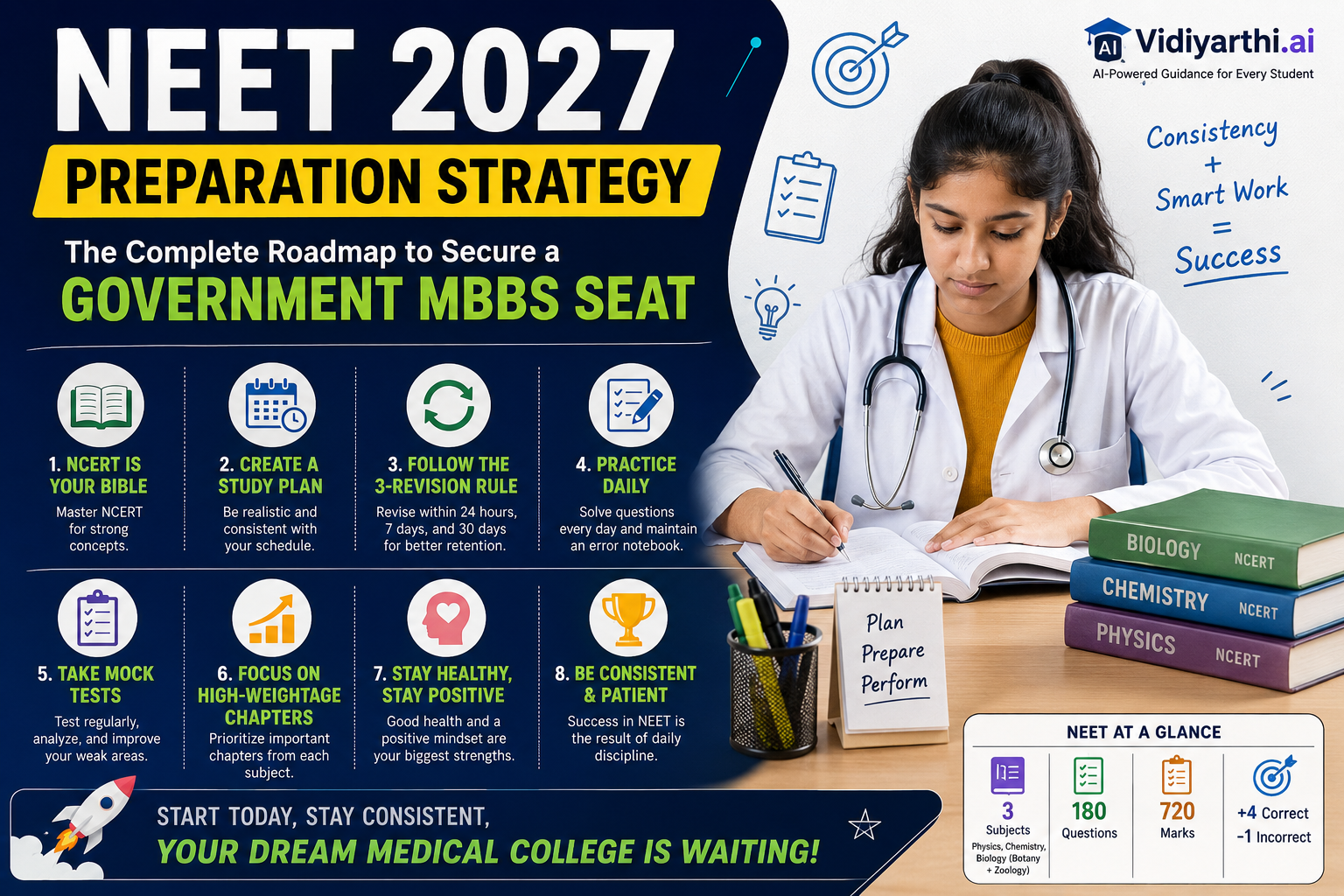
Step 1: Understand the NEET Exam Pattern
Before starting preparation, you must understand the examination structure.
Subjects Covered
-
Physics
-
Chemistry
-
Biology (Botany + Zoology)
Total Questions
-
180 Questions
Total Marks
-
720 Marks
Marking Scheme
-
+4 for every correct answer
-
-1 for every incorrect answer
Biology carries the highest weightage and should be your strongest subject.
Step 2: Make NCERT Your Bible
One of the biggest mistakes students make is collecting too many books.
Top rankers repeatedly emphasize one thing:
Master NCERT before touching advanced reference books.
For Biology
Read every line of NCERT multiple times.
Focus on:
-
Diagrams
-
Tables
-
Scientific names
-
Examples
-
Exceptions
More than 80% of Biology questions are directly or indirectly based on NCERT.
For Chemistry
NCERT is extremely important for:
-
Organic Chemistry
-
Inorganic Chemistry
For Physics
NCERT concepts must be clear before solving advanced problems.
Step 3: Create a Realistic Study Schedule
Many students create 12–14 hour schedules and fail within a week.
Instead:
Class 11 Students
-
5–6 hours self-study daily
Class 12 Students
-
6–8 hours self-study daily
Droppers
-
8–10 productive hours daily
Focus on quality rather than quantity.
Step 4: Follow the 3-Revision Rule
A chapter studied once is usually forgotten.
Every chapter should be revised:
First Revision
Within 24 hours.
Second Revision
Within 7 days.
Third Revision
Within 30 days.
This technique dramatically improves retention.
Step 5: Practice Questions Every Day
Knowledge without practice has little value in competitive exams.
Daily Targets:
-
Biology: 100 Questions
-
Chemistry: 50 Questions
-
Physics: 40 Questions
Maintain an error notebook.
Whenever you make a mistake:
-
Write the question
-
Write the correct concept
-
Review weekly
This single habit can improve your score by 50–100 marks.
Step 6: Start Mock Tests Early
Do not wait until the final months.
Recommended Timeline
Class 11
-
Topic-wise tests
Class 12
-
Chapter-wise and unit tests
Last 6 Months
-
Full syllabus mock tests
After every mock test:
-
Analyze mistakes
-
Identify weak chapters
-
Revise concepts immediately
Test analysis is more important than the test itself.
Step 7: Prioritize High-Weightage Chapters
Some chapters consistently contribute more questions.
Biology
-
Human Physiology
-
Genetics
-
Biotechnology
-
Ecology
-
Reproduction
Chemistry
-
Chemical Bonding
-
Coordination Compounds
-
Organic Reactions
-
Electrochemistry
Physics
-
Mechanics
-
Current Electricity
-
Modern Physics
-
Thermodynamics
Mastering these chapters can significantly boost your score.
Step 8: Avoid Common NEET Preparation Mistakes
Mistake #1
Collecting too many study materials.
Mistake #2
Ignoring NCERT.
Mistake #3
Not revising regularly.
Mistake #4
Skipping mock tests.
Mistake #5
Comparing yourself with others.
Remember: NEET is a marathon, not a sprint.
Step 9: Maintain Physical and Mental Health
Your brain performs best when your body is healthy.
Essential Habits
-
Sleep 7–8 hours daily
-
Drink sufficient water
-
Exercise for 20–30 minutes
-
Limit social media usage
-
Take short breaks while studying
Burnout can reduce performance even after months of hard work.
Final Thoughts
Cracking NEET is not about studying the most hours. It is about studying the right material, revising consistently, solving quality questions, and maintaining discipline for an extended period.
If you start today and follow a structured plan, a government MBBS seat is absolutely achievable.
Success in NEET is not decided on exam day—it is decided by the habits you build every day.
Start now. Stay consistent. Your dream medical college is waiting.